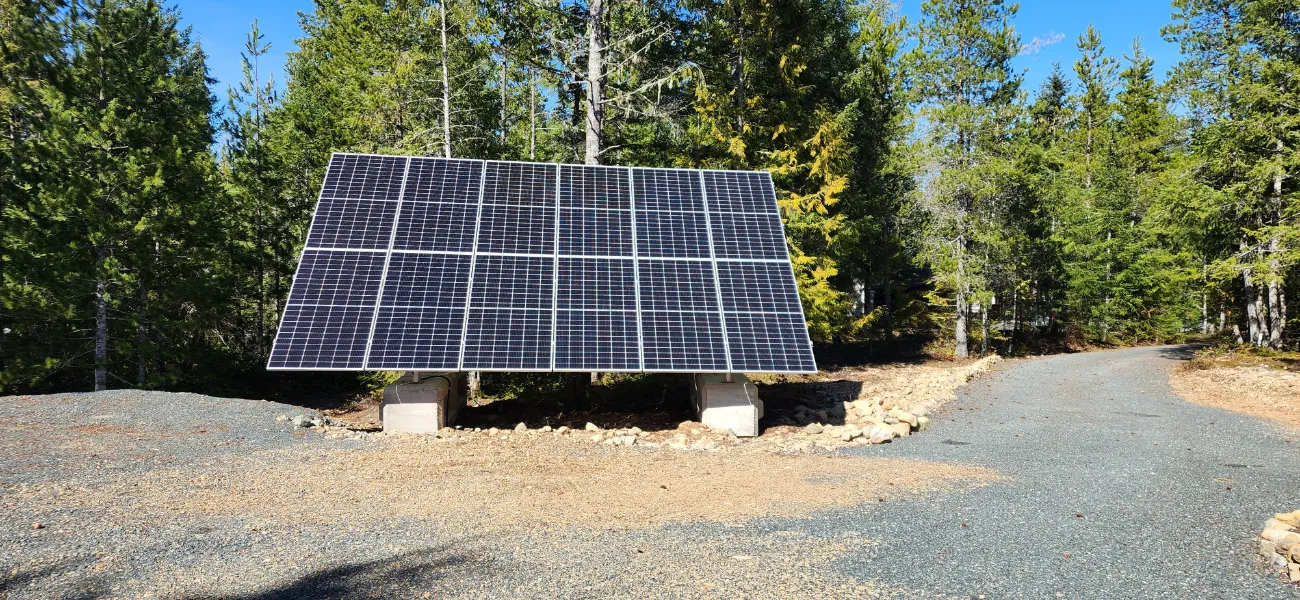
How to Size a Solar System for a Remote Cabin or Homestead
Living off-grid in rural British Columbia comes with serious rewards and serious responsibilities. One of the biggest is making sure your solar power system is properly sized. If it’s too small, you’ll be left scrambling for power in the winter. If it’s too big, you might overspend on equipment you don’t need.
This guide walks you through the basic process of sizing a solar system for your remote cabin, homestead, or off-grid property, starting with electrical loads and moving through solar panels, battery storage, and backup generator considerations.
1. Start with your daily electrical loads
The first step is figuring out how much electricity you actually use in a day. This is called a load calculation, and it’s the foundation of your entire solar system design.
How to calculate your loads:
-
- Make a list of every electrical device you use—lights, fridge, water pump, router, phone charger, etc.
- For each item, multiply the wattage by the number of hours you use it per day.
- Add up the total watt-hours (Wh) to get your daily energy use.
Here’s a quick example:
| Device | Watts | Hours/Day | Watt-Hours/Day |
|---|---|---|---|
| LED lights (4) | 10 | 5 | 200 |
| Fridge (efficient) | 100 | 24 | 1,200 |
| Water pump (intermittent) | 500 | 0.5 | 250 |
| Phone charger | 10 | 2 | 20 |
| Daily Total | 1,670 Wh |
Plan for your highest-use season—usually winter—when sunlight is scarce and heating systems or lighting needs are higher.
2. Factor in local solar potential
How much solar energy your system can collect depends heavily on your geographic location and sun exposure.
-
- Coastal areas like Vancouver Island or Bella Bella can be cloudy for days.
- Properties surrounded by tall trees or mountains may have limited sun hours.
- Use a tool like PVWatts or a BC-specific solar map to estimate peak sun hours for your area.
A general rule: many off-grid properties in BC can expect 2–4 hours of peak sun per day in winter and 4–6 hours in summer.
3. Size your solar panel array
Once you know your daily energy needs and average sun hours, you can size your solar array.
Step-by-step:
-
- Take your daily watt-hour total.
- Divide by average daily sun hours.
- Add 25–30% to account for efficiency losses, cloudy days, and snow cover.
Using the earlier example:
-
- 1,670 Wh ÷ 3 sun hours/day = 556 watts of panels needed.
- Add 30% buffer: 556 × 1.3 = ~725 watts
- That’s roughly two to three 350W solar panels.
Oversizing a little is smart for off-grid setups. You don’t want to run short during a dark, wet week in February.
4. Determine your battery storage needs
Your batteries store the energy your panels collect. If your storage is too small, you’ll run out of power. Too large, and you’re paying for capacity you don’t use.
How much do you need?
A common approach is to multiply your daily usage by how many days of autonomy you want (days you can go without sun).
-
- 1,670 Wh/day × 2 days = 3,340 Wh = 3.34 kWh
- Add a buffer → aim for 4–5 kWh usable storage
Important: Not all battery capacity is usable. For example:
-
- Lead-acid batteries should only be discharged to 50%
- Lithium batteries can be discharged 80–100%
So to get 4 kWh of usable energy, you’d need:
-
- ~8 kWh of lead-acid capacity, or
- ~4–5 kWh of lithium capacity
Lithium vs. Lead-Acid:
| Feature | Lithium | Lead-Acid |
|---|---|---|
| Usable capacity | 80–100% | 50% |
| Lifespan | 10–15 years | 5–7 years |
| Cost | Higher upfront | Lower upfront |
| Temp-sensitive | Needs insulated space | Can tolerate cold better |
5. Decide if a backup generator is needed
Even with a well-sized solar and battery system, there may be times you need extra help—especially in the dead of winter or if you have high-starting-load tools.
Good reasons to include a generator:
-
- Days of snow or rain when panels produce little or nothing
- Occasional use of high-draw tools (e.g., power saws, welders)
- Peace of mind during emergencies or equipment failures
Generator sizing tip:
-
- Match it to your inverter’s charging input and peak loads.
- Look for inverter-style generators for quiet operation and fuel efficiency.
- Consider propane, diesel, or gas depending on what’s easiest to store on your site.
6. Don’t forget the other system components
Your solar system is more than just panels and batteries. Other critical components include:
Charge Controller
-
- MPPT (Maximum Power Point Tracking) is recommended for off-grid systems.
- MPPT is more efficient than PWM, especially in cold or variable light conditions.
Inverter
-
- Converts DC battery power to AC household power.
- Use a pure sine wave inverter for sensitive electronics and appliances.
Monitoring and Safety
-
- Battery monitors help prevent over-discharge and track system health.
- Add breakers and disconnects for safety and code compliance.
7. Real-world example: Remote Cabin in Coastal BC
Let’s say you’re building a year-round cabin on Quadra Island. You estimate:
-
- Daily usage: 2,000 Wh
- Winter sun hours: 2.5/day
You’ll need:
- 1,000W of solar (3 × 350W panels)
- 6 kWh of lithium storage for 2–3 days of autonomy
- 3,000W inverter
- 3.5 kW backup generator
That setup gives a solid mix of daily coverage, winter resilience, and peace of mind.
Why choose Kingsley Power?
At Kingsley Power, we specialize in off-grid power systems for cabins, homesteads, and remote island properties throughout the BC coast. Here’s what sets us apart:
-
- Licensed electrical contractor with deep off-grid experience
- We understand the challenges of remote living—because we do it ourselves
- We operate a 36-foot aluminum catamaran to deliver materials and equipment to remote islands and coastal communities
- We’re passionate about helping people gain energy independence through practical, efficient, and sustainable systems
Proudly Serving Remote and Coastal BC
-
- Vancouver Island
- Gulf Islands
- Discovery Islands
- Sunshine Coast
- Bella Bella and Central Coast
- Hard-to-access mainland and island homesteads
- First Nations communities
Ready to size your off-grid solar system?
Get in touch with Kingsley Power today. We’ll help you size and design a solar system that actually works, whether you’re building a weekend cabin or running a full-time homestead in one of BC’s most remote corners.