Residential Grid-Interactive Solar & Backup Power
This project started with a straightforward request from homeowners in Kingsley Power's local community: keep the important parts of the house running when utility power goes down.
Rather than installing a conventional standby generator that provides value only during an outage, Kingsley Power designed a grid-interactive solar and battery system that works alongside the utility during normal operation while providing automatic backup power when the grid fails.
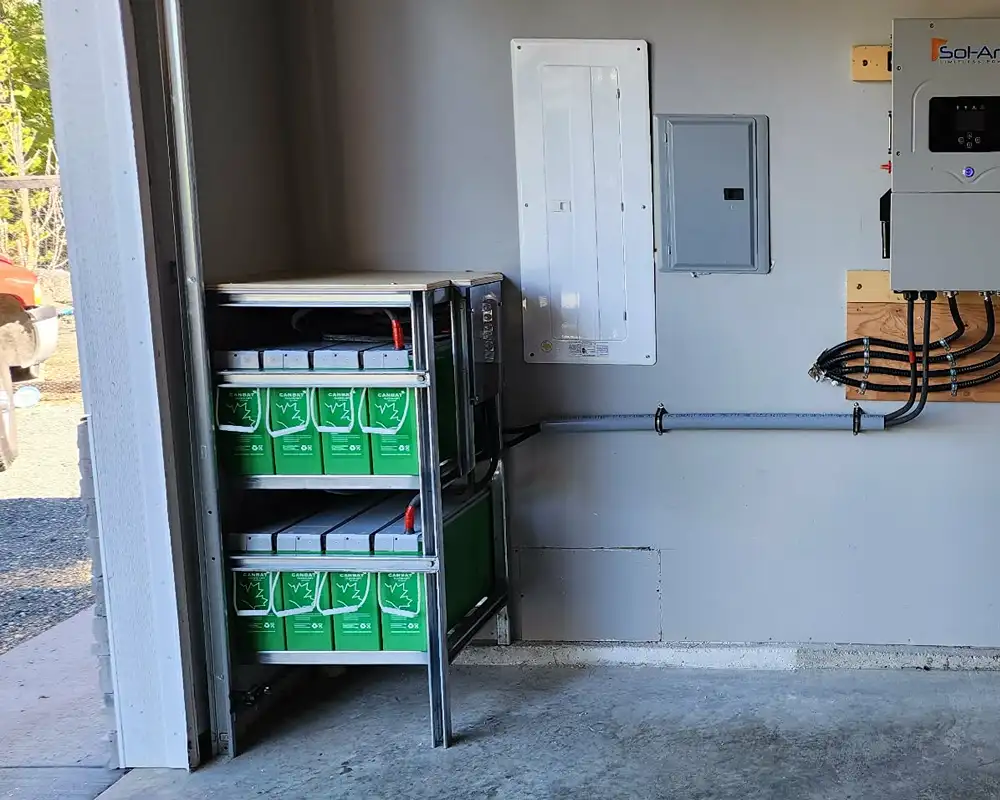
The system combines approximately 5 kW of solar, a Sol-Ark hybrid inverter, lead-carbon battery storage, dedicated critical-load distribution and generator backup. Particular attention was given to the home's well pump so the property could maintain its water supply during an extended outage.

A Grid-Interactive Solar & Backup System
The system is built around a Sol-Ark hybrid inverter connected to ten 500-watt solar modules, providing approximately 5 kW of photovoltaic capacity.
During normal operation, solar energy can be used by the home, reducing the amount of electricity purchased from the utility. The inverter also maintains the battery bank so stored energy is available when needed.
If utility power fails, the system automatically transitions the dedicated critical loads to battery power.
The installation includes:
-
- 5 kW ground-mounted solar array
- Sol-Ark hybrid inverter
- Lead-carbon battery storage
- Dedicated critical-load distribution
- Automatic battery backup
- Well pump backup
- Generator connection for extended outages
This gives the property more than one source of energy rather than relying entirely on the utility or a standby generator.
The objective wasn't simply to install batteries for the next outage. It was to make solar, storage, utility power and backup generation work together as one system.
Choosing the Right Inverter for the Application
For complex fully off-grid systems, Kingsley Power generally prefers Victron equipment because of its modularity, generator integration and the level of control available for remote power systems.
This project had different requirements.
For a grid-connected residential application, the Sol-Ark hybrid platform provided a practical way to integrate solar production, battery storage, utility interaction and backup capability within a single system.
That simplified the installation while providing the functionality the homeowners actually needed.
This distinction is important to the way Kingsley Power approaches system design. There isn't one inverter, battery or equipment platform that is automatically the right choice for every project.
The equipment should be selected after understanding what the system needs to do.
Good system design means choosing equipment for the application rather than forcing every project onto the same platform.

Why the Solar Array Went on the Ground
The home's roof is partially shaded by surrounding trees for significant portions of the year. Installing the solar modules there would have compromised energy production.
Instead, Kingsley Power installed a ground-mounted array consisting of ten 500-watt solar modules.
This allowed the location, orientation and angle of the array to be selected around solar production rather than being dictated by the direction and shape of the house roof.
Ground mounting also provides practical long-term advantages. The modules are easier to inspect, clean and service, and the array remains accessible if changes or expansion are required later.
Modern bifacial solar modules can provide an additional benefit. Depending on array height, spacing, ground conditions and reflected light, the rear surface of a bifacial module can contribute additional production.
Where the property allows for it, Kingsley Power generally sees significant advantages in keeping solar equipment accessible and positioning it where it can perform effectively.
Battery Storage, Critical Loads & Generator Backup
The lead-carbon battery bank was selected for the system's original purpose: remaining charged and ready to provide backup power during an outage. When utility power fails, the battery-backed distribution keeps critical loads operating, including the home's well pump.
A generator connection provides additional backup if an outage extends beyond available solar production and battery capacity.
Utility Power → Solar → Battery Storage → Generator Backup
Battery technology has evolved since this installation. Today, lower lithium battery costs and more advanced energy management can make daily cycling, self-consumption and energy shifting practical as well.
The principle remains the same: choose the battery technology and operating strategy around what the property actually needs.


One Contractor for the Site Work & Power System
Kingsley Power handled more than the electrical portion of the installation.
Using its own backhoe, Kingsley Power excavated the underground electrical trench and placed the concrete lock blocks required for the ground-mounted solar array.
Handling this work directly allowed the civil and electrical portions of the project to be coordinated as one installation instead of requiring the homeowners to organize several different contractors.
The finished installation also includes purpose-built electrical distribution, generator provisions and custom engraved lamicoid labelling identifying system configuration and operating information.
Those details become particularly important with backup and hybrid power systems. The installation needs to work properly today, but it should also be organized and clearly documented so someone looking at the equipment years later can understand how the system was intended to operate.
The result is a grid-connected home with several layers of energy security. Solar contributes useful energy during everyday operation. Battery storage keeps critical loads operating when the utility fails. The well system remains available, and generator backup provides another source of energy during a prolonged outage.
A resilient power system isn't necessarily about having the biggest battery or generator. It's about giving the property several well-integrated ways to keep essential equipment operating.
Start With a System Designed Around Your Property
Solar, battery storage and backup power work best when they are designed around the loads that actually matter. Kingsley Power can assess your property, energy requirements and backup priorities before recommending the right system approach.
The assessment is the first phase of designing the right system. If Kingsley Power is retained to supply and build the resulting system, the assessment fee can be applied toward the project.