
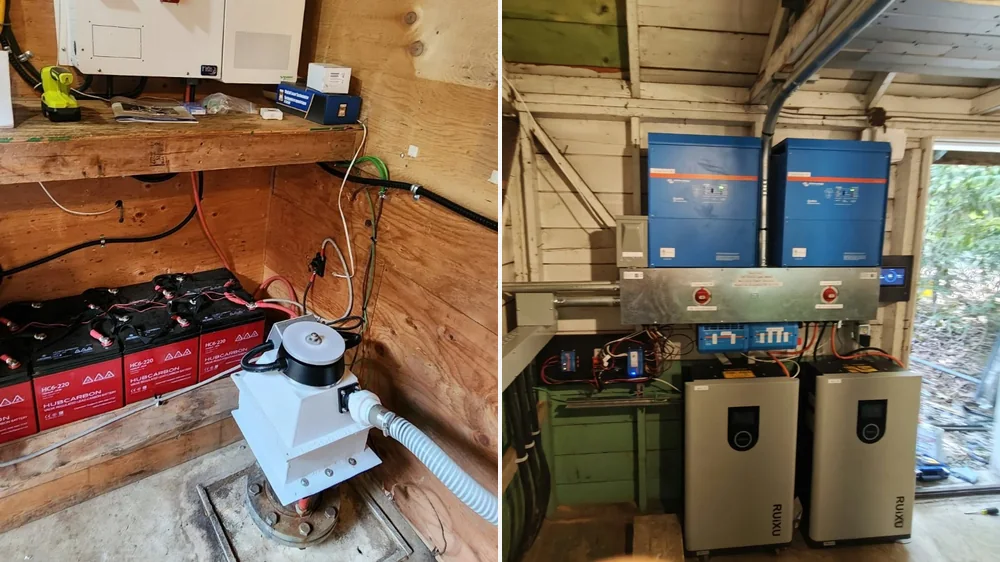
Lithium Batteries in Microhydro Systems: Why They Change the Rules
Microhydro has one major personality trait that sets it apart from almost every other renewable energy source: it does not care that your batteries are full. The sun goes down. The wind stops. But if there’s water coming down the pipe, your turbine is going to keep making power whether you want it or not. With a traditional lead-acid battery bank, that was relatively easy to deal with. Lithium is a different animal. It charges fast, it’s efficient, it lasts a long time — but it does not like sitting at 100%, it does not like heat, and if the BMS decides it has had enough and disconnects, the water coming down the hill does not give a fuck. The turbine is still spinning, the energy is still coming, and now you had better have somewhere safe for it to go.
When the Battery Says No
This is where alternator type starts to matter.
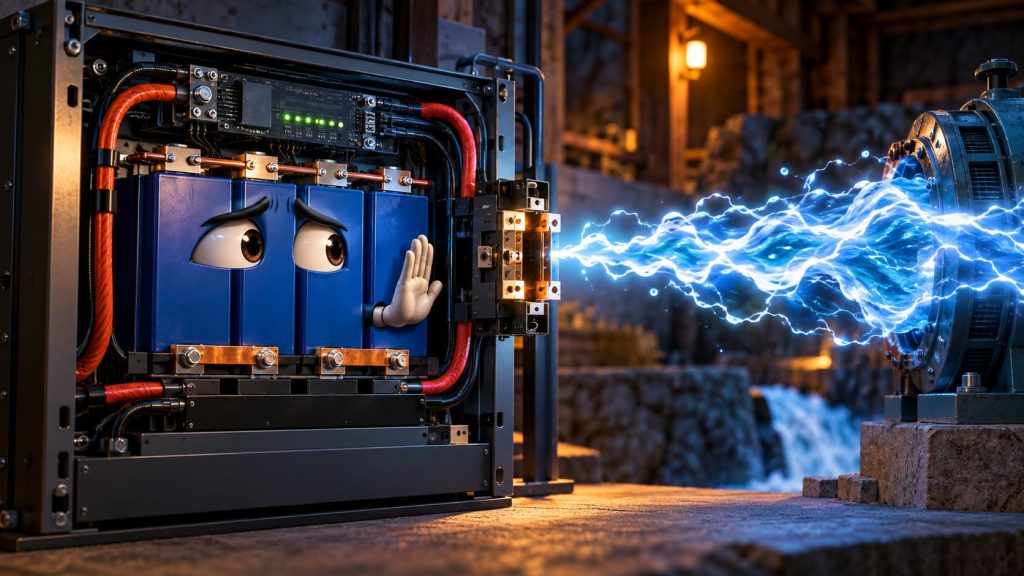
Some hydro generators have their own voltage regulation. On one system I installed, the alternator was self-excited and internally regulated, so under normal conditions it has a built-in ceiling on how hard it can push the DC bus. That adds a layer of protection, but I still would not trust that regulator as the only thing standing between a lithium battery bank and a serious overvoltage event. Regulators fail, wiring fails, control systems do stupid things, and eventually somebody has to assume something will go wrong.
My preferred approach is to have an independent emergency shutdown that does not rely on the normal charging controls or the battery BMS. In that installation, the plan is a spring-loaded diversion gate held in position electrically. If the system sees a dangerous voltage or loses control power, the mechanism releases and physically diverts the water away from the turbine.
Permanent-magnet turbines are an even more obvious case. They do not have an excitation system that can simply reduce field current and limit output. If the electrical load suddenly disappears, turbine speed and open-circuit voltage can climb very quickly. For those systems I use an independent voltage-based relay as the emergency layer. That relay can either trigger a water diversion mechanism or open a contactor and electrically disconnect the turbine.
Letting a turbine spin unloaded is not ideal. Depending on the machine, it can overspeed, generate extremely high voltage, damage bearings or mechanical components, and in extreme cases physically come apart. That is not the normal outcome, but it is also not something I am willing to rely on being “probably fine.”
The important point is that the emergency protection needs to be independent of the thing that just failed. If the battery BMS opens, the turbine still needs a safe state. If the normal diversion controller locks up, the turbine still needs a safe state. If the inverter dies, the turbine still needs a safe state.
A properly designed hydro system should always have an answer to one question: If every normal load suddenly disappears, what happens to the water and where does the energy go?
Diversion Loads: Why Lead-Acid Was So Easy
Traditional microhydro systems built around lead-acid batteries were actually pretty straightforward to control. Lead-acid likes to stay full, it tolerates being held at a high state of charge far better than lithium, and excess energy can be dumped based largely on battery voltage alone. As the bank voltage rises, a diversion controller simply sends more and more power into a resistive load. When the batteries need more charge again, it backs off. Simple, effective, and fairly forgiving.
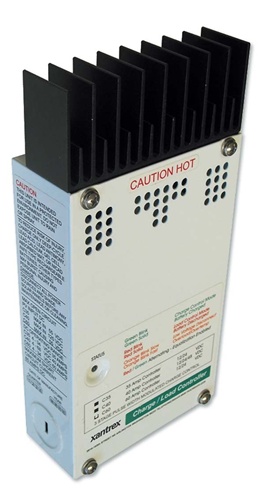
A good example is the old Xantrex PWM diversion controller. These controllers watch battery voltage and pulse power into a dump load to hold the bank where you want it. In a lead-acid system, that works well because voltage is a reasonably useful indicator of battery state, and the battery itself is happy to sit full while the controller trims off the excess. Water heating elements, air heaters, or dedicated resistor banks all work well as dump loads. This is one of the reasons lead-acid stayed common in microhydro for so long: the control strategy was simple and the battery chemistry was forgiving. If the turbine kept making power, the diversion controller just bled off what the batteries didn’t need. There was no BMS waiting to abruptly disconnect, no cell-level protection logic to worry about, and no big philosophical question about whether the battery should really be sitting at 100% all day, every day. In other words, the old-school hydro recipe was pretty simple: battery voltage rises → controller dumps more power battery voltage falls → controller dumps less power And for lead-acid, that worked just fine. Lithium changes all of that.
Why Lithium Breaks the Old Diversion Logic
Lithium batteries behave very differently. In particular, LiFePO₄ has a very flat voltage curve through most of its useful state of charge. That means battery voltage alone is a much poorer indication of what is actually happening inside the battery. A 48 V lithium bank can sit at nearly the same voltage over a surprisingly large portion of its usable capacity, then climb rapidly as it approaches full charge.
That makes the old-school strategy of simply watching battery voltage and progressively diverting power a lot less useful. By the time voltage starts climbing hard, the battery may already be nearly full and individual cells may be approaching their upper limits.
There is another problem: lithium batteries do not benefit from sitting at maximum state of charge all day. For good battery life, I would much rather operate a hydro battery through a sensible working range and only bring it fully charged when there is a reason to do so, such as cell balancing. Holding a lithium bank at very high SOC continuously — especially in a hot electrical room — is unnecessary stress on the cells.
And then there is the BMS
Every decent lithium battery has a Battery Management System watching individual cell voltages, temperatures and current. If one cell reaches its protection limit, the BMS can tell the charging equipment to stop. If that communication fails, or the charger ignores it, the BMS may eventually do the only thing it has left to protect the cells:
disconnect the battery
That is perfectly reasonable from the battery’s point of view.
From the hydro turbine’s point of view, however, you may have just removed the biggest load in the system in a fraction of a second.
The water is still coming down the pipe. The turbine is still spinning. The creek does not give a fuck that your BMS has decided charging is over.
That is why I do not consider the BMS to be the charge controller in a microhydro system. The normal control system should prevent the battery from ever reaching the point where the BMS has to save it. The BMS is the final layer of protection — not the device you should be bouncing off every afternoon.
Why Lithium Still Needs a Full Charge Occasionally
If keeping a lithium battery below 100% is better for longevity, it raises an obvious question: why charge it full at all?
The first reason is state-of-charge accuracy. Most lithium battery systems estimate SOC partly by measuring current flowing into and out of the battery and keeping a running total. That works very well, but no current sensor is perfectly accurate. After enough partial charge and discharge cycles, those tiny measurement errors start adding up and the reported SOC can slowly drift away from the battery’s actual state of charge.
Eventually the system needs a known reference point.
When the battery reaches its configured full-charge conditions, the BMS or battery monitor can synchronize its SOC calculation and start again from a known point. Exactly how this happens depends on the battery and BMS, but the principle is the same: occasionally reaching a properly defined full-charge condition helps keep the SOC reading honest.
The second reason is cell balancing.
A lithium battery is made up of individual cells connected in series. Those cells are never absolutely identical, and over time small differences in capacity, internal resistance and self-discharge can cause their voltages to drift apart. Most BMSs only begin actively or passively balancing cells once they reach a certain voltage near the upper end of the charging range.
If a battery is operated between, for example, 20% and 80% SOC forever, it may never reach the voltage where meaningful balancing occurs. Over enough time, one cell may begin reaching the upper voltage limit before the others, reducing the usable capacity of the entire battery.
That does not mean the solution is to leave it at 100% all day.
In continuous microhydro applications, I generally prefer to operate the battery around a lower upper-SOC target — often somewhere around 80% — and treat a full charge as an intentional maintenance event rather than the normal operating condition. That leaves plenty of usable capacity for large loads while also giving the system a buffer if the hydro suddenly disappears because of a plugged intake, penstock problem, low water condition or mechanical failure.
With a programmable control system, this becomes much easier. Using something like Victron GX and Node-RED, the system can normally regulate around the desired SOC target, then periodically allow the battery to reach its proper full-charge conditions. Depending on the battery, balancing behaviour and application, that might be once a week, every couple of weeks, or whatever interval makes sense for that particular installation.
Once synchronization and balancing are complete, the system can return to its normal operating range.
Instead of keeping the battery full because the hydro never stops, we decide when being full is actually useful.
Controlling Excess Hydro Power
Modern programmable control gives us far more options than the old voltage-only diversion systems. I commonly use Node-RED running on a Victron GX device to make decisions based on battery state of charge, cell voltage, battery current, time, temperature and other system data.
Before throwing energy away, I would rather use it. Victron’s integration with Shelly relays makes it easy to bring on opportunity loads such as domestic hot water, space heating, pumps or other equipment when excess generation is available. Thermal storage can also be extremely useful here, allowing surplus electrical energy to be stored as heat for later use.
Once the useful loads are satisfied, the next step is dedicated diversion. I prefer using several smaller resistive loads in stages rather than switching one enormous dump load on and off. On one microhydro system I built, I use a five-stage diversion system, progressively adding load as required.
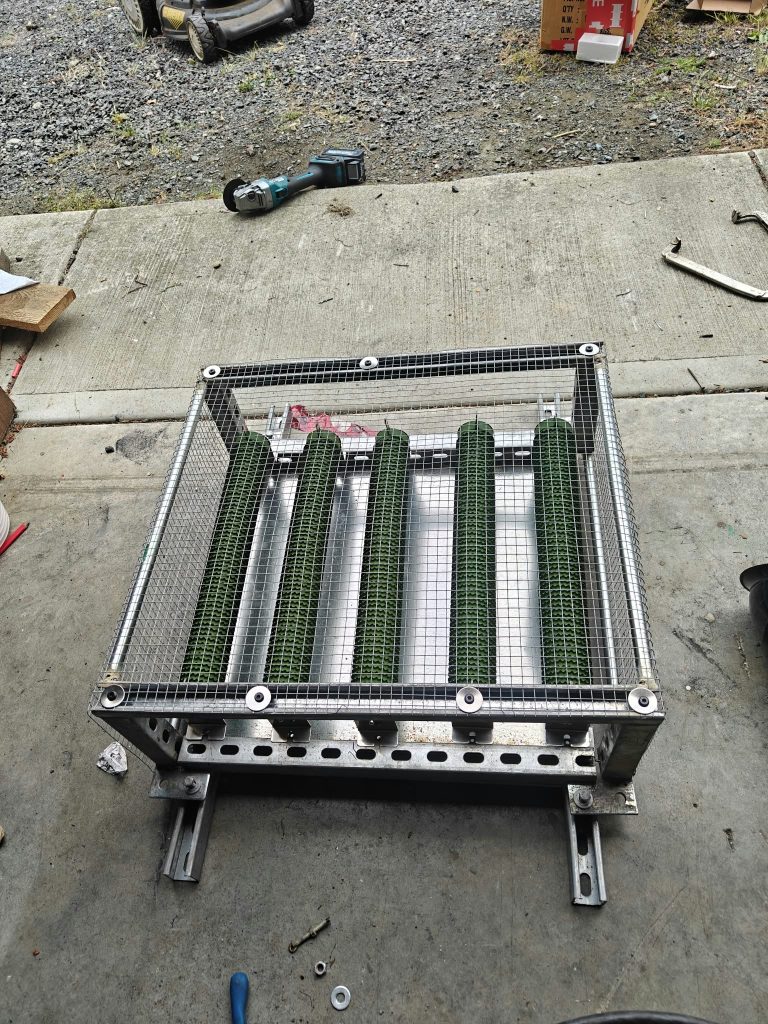
Staging also gives much smoother control. With Node-RED, I can add hysteresis, delays and sequencing so the system is not constantly hammering contactors on and off or making large instantaneous changes in electrical load. The control logic can be sophisticated while the actual diversion hardware remains relatively simple.
All of that handles normal operation. But normal control is not the same thing as emergency protection. Software can crash, communications can disappear, relays can fail and batteries can disconnect. For that reason, I still want one completely independent layer whose only job is to react when everything else has gone wrong.
The Oh-Shit Relay
All of the control described above is for normal operation. I still want one completely independent layer for the moment when everything else decides to shit the bed.
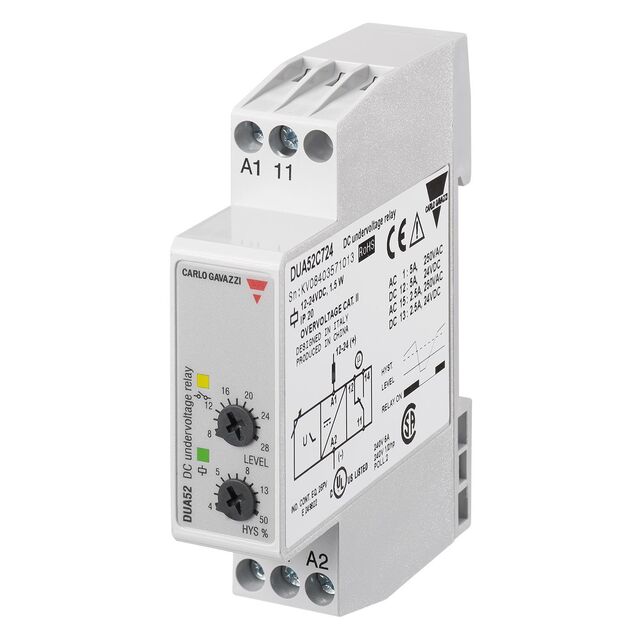
For this job I like Carlo Gavazzi voltage-monitoring relays. Carlo Gavazzi is already a familiar name in the Victron ecosystem—their energy meters are directly supported by Victron GX systems—but the voltage relay I use for emergency protection is deliberately much simpler. It does not need CAN, Ethernet, Node-RED or a functioning BMS. It watches voltage and provides a set of relay contacts when a predetermined limit is reached.
That independence is exactly what I want. If the DC bus reaches a voltage that it should never reach during normal operation, I am no longer interested in sophisticated control logic. Something has already gone wrong. At that point the job is simply to put the hydro system into a safe state.
How that is accomplished depends on the turbine and the site. One option is a fail-safe diversion gate, where a spring-loaded mechanism physically redirects the water away from the turbine when the control circuit releases. Another is a motorized valve or other method of shutting off the water supply. In some installations, the emergency action can simply open a contactor and electrically unload the generator, allowing the turbine to freewheel.
Freewheeling needs to be treated carefully. Some turbines can tolerate their runaway speed; others cannot, and permanent-magnet machines can produce very high open-circuit voltage when unloaded. Whether electrical disconnection is an acceptable emergency strategy depends on the turbine’s mechanical design, maximum runaway RPM and insulation/voltage ratings. Physically removing or diverting the water is generally the cleaner way to remove the energy source altogether.
I have also used the old Xantrex C-Series PWM diversion controllers as an independent layer of runaway protection. They can operate entirely from battery voltage and continuously divert power into a resistive load without relying on the primary automation system. Xantrex specifically designed the C-Series for diversion control with sources including hydro and wind, and their documentation stresses that the diversion load must remain available and be capable of absorbing the generator’s maximum output.
There is no single emergency method that is right for every turbine. The important part is that the last line of defence is independent, simple and capable of working when the normal control system has already failed.
Lithium batteries are a huge improvement for microhydro, but they are not a drop-in replacement for lead-acid. They are more efficient, lighter, cleaner, and far more capable — but they also demand better control, better monitoring, and a proper plan for excess energy when the battery no longer wants it. Done properly, lithium and microhydro are an excellent combination. The key is understanding that the battery, the turbine, the diversion system, and the emergency protection all need to work together as one system.
Lithium does not make microhydro harder — it just makes lazy system design a lot less forgiving.